

From Sounds to Sentences: The Magical Journey of Language in Montessori

The journey of language in the Montessori environment is a rich, immersive process that begins the moment a child enters the classroom. Here’s an in-depth look at how language unfolds for children, starting with spoken language at age 2–2.5, moving through writing and reading, and culminating in the joyful, complex understanding of language’s structure and meaning.
Spoken Language: Foundations from Day One
From their very first day, children in the Montessori classroom are surrounded by rich verbal interactions. Guides engage in constant conversation, using clear, precise language while narrating routines, introducing new vocabulary, telling stories, and listening attentively to the children’s responses. The classroom itself is a language-rich environment, with children eagerly absorbing words through daily experiences and intentional lessons.
Montessori educators recognize the “sensitive period” for language, a time of intense linguistic absorption in early childhood. Young children, even before they can speak fluently, are already developing robust language pathways simply by listening and participating in conversation. The focus is not just on vocabulary, but also on understanding meaning, intent, and the social use of language.
From Sounds to Structure: Sound Games and Phonemic Awareness
A cornerstone of Montessori language work is the use of sound games. Before children are introduced to letters, teachers play listening and phonetic games that build phonemic awareness, the ability to hear and identify the individual sounds in words. This stage is essential because it creates the foundation for future reading and writing success.
Importantly, Montessori educators teach the sound of each letter before introducing its name (e.g., “a” as /a/, not “ay”). This makes blending and decoding far more intuitive when children encounter words in print, as they can immediately connect symbols to spoken sounds. These games are playful and engaging, helping children develop a love of language while building crucial auditory and memory skills.
The Path to Writing: Cursive Comes First
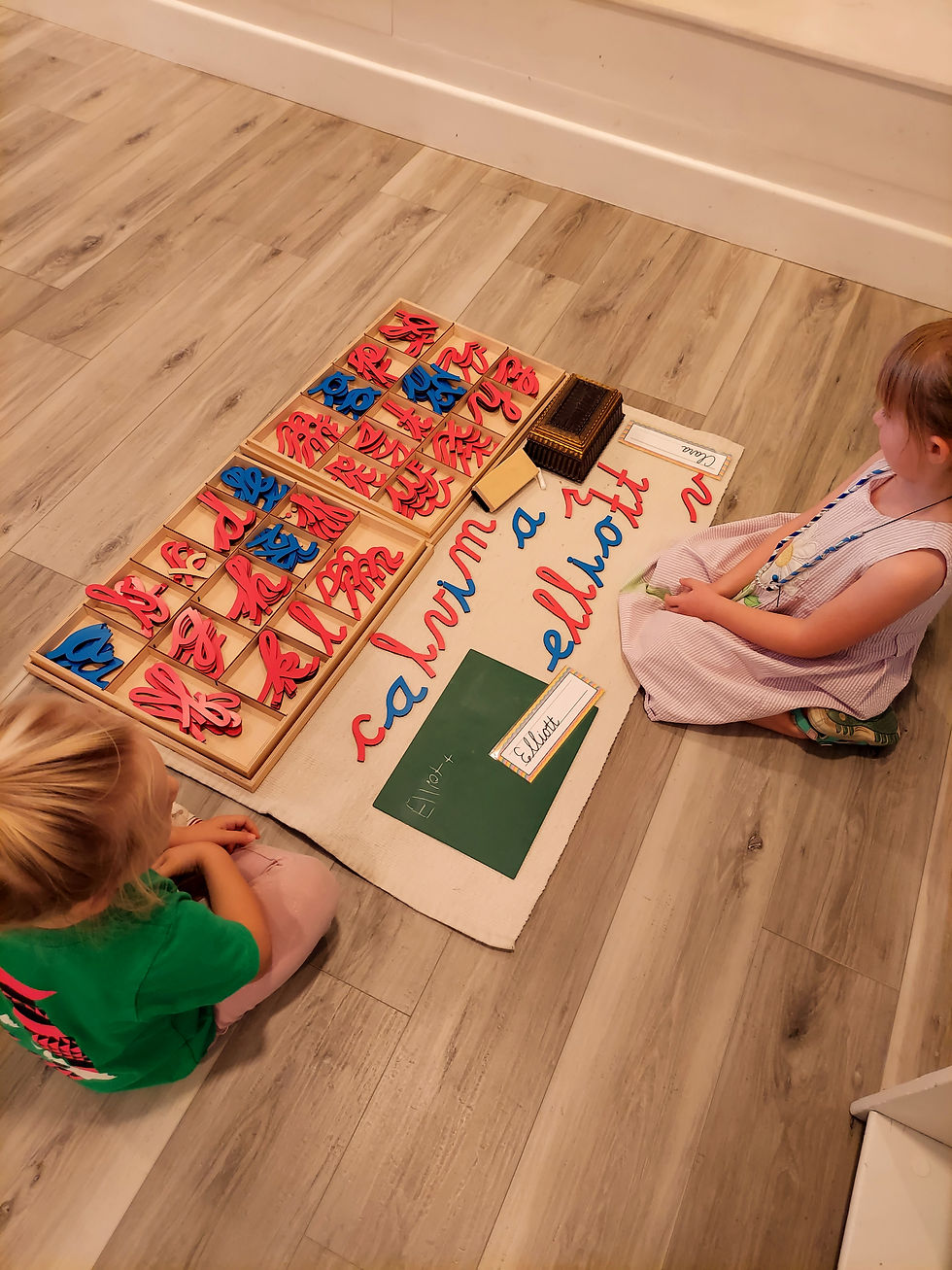
In Montessori, writing is introduced before reading. This is because physically forming letters with tools like sandpaper letters and moveable alphabets helps children internalize the shapes and sounds of each letter. Tracing sandpaper letters, for example, gives tactile feedback and aids in muscle memory. The writing process strengthens understanding of how language works, and children build words from sounds, gaining a solid grasp of both.
Cursive writing is taught first in many Montessori environments because its fluid, connected motion is often easier for young children’s developing hands. The continuous script also mirrors the connected flow of language, reducing confusion between similar printed letters and encouraging a natural progress from sound to word.
Reading: Joyful Discovery After Mastery of Writing
Because children already know the sounds and the physical act of writing words, reading comes organically. They begin by reading words they’ve built and written themselves. The process is joyful and empowering; children realize they can read because they already understand how written language is constructed. As confidence grows, reading extends to phrases, sentences, and beautiful stories. Each step is concrete, meaningful, and child-driven.
Beyond the Basics: Analyzing Language and Sentence Structure
As children become more skilled, Montessori classrooms introduce the analysis of language structure. This includes activities that explore the function of words within a sentence (grammar) and the relationships between them (sentence analysis). Children use hands-on materials to group words by type: nouns, verbs, adjectives, and physically build and break down sentences, deepening their understanding of syntax and communication.
These activities make abstract concepts tangible and enjoyable, fostering a powerful and nuanced grasp of language that lasts a lifetime.
The Joy, Importance, and Power of Montessori Language
Language is everywhere in the Montessori environment: in morning greetings, snack-time storytelling, sound games, sandpaper letters, and thoughtful grammar work.
Every lesson, from age 2 onward, is carefully crafted to nurture confidence, curiosity, and a genuine love of language.
Most importantly, Montessori children are not pushed but inspired, each child’s developmental pace is honored, and every small success is celebrated.
In summary, language in Montessori is a holistic, joyful journey, from the first words and sounds to writing and reading, culminating in the mastery of the beauty and power of communication.
Curious how our Montessori environment can spark a love of language in your child? Schedule a visit and discover the difference we can make together!


Comments